
Albert Houthuesen: Moon, Muse and Poet Clown
Exhibition at the Danum Gallery, Library and Museum
21st January – 15th April 2023
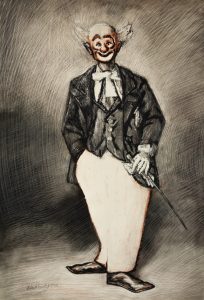
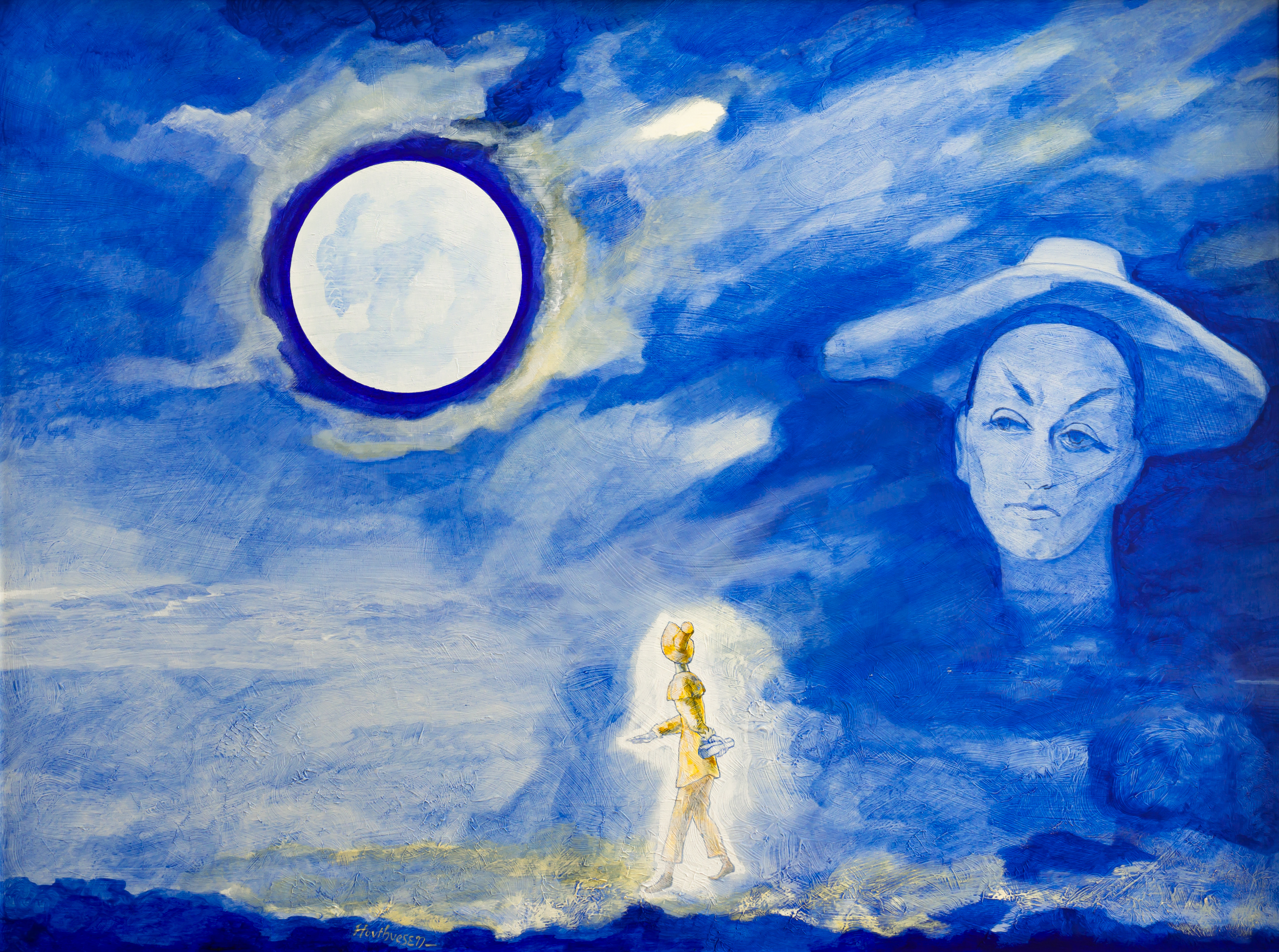
The latest exhibition at the Danum Gallery, Library and Museum in Doncaster sheds light on the fascinating story of Albert Houthuesen (1903-1979). Albert was a Dutch-born artist who spent all his adult life in Britain, including a period living in Doncaster during the Second World War.
The exhibition, which brings together around 70 artworks, follows Houthuesen’s life. From his early years living in poverty in London, to his time in Doncaster working at the Locomotive Works during the Second World War, and to later life, when a number of solo exhibitions in London established his artistic reputation.
It was during his years in Doncaster that Houthuesen started working on a series of images of clowns and harlequins. In particular, he was inspired by a travelling family of clowns called the Hermans, whom he saw performing at the Grand Theatre in the town. Some of these pictures are in the collections of the Tate and the V&A Museum in London.
“These sketches at the Doncaster Theatre were the first real clown studies I did. The Hermans were a family of musical clowns. I used to go round at the back and tell them how marvellous I thought they were. They couldn’t quite understand this because nobody else bothered. People rolled in, laughed like hell and went out.”
Houthuesen talking about the Hermans in the book ‘Walk to the Moon’, based on taped conversations in 1967
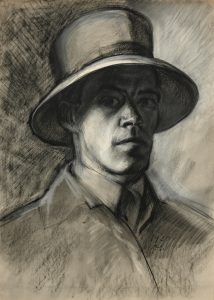
While the exhibition focuses on the artwork that Houthuesen produced in Doncaster, it also covers his whole creative life, from early still-lifes and portraits, to landscapes and seascapes produced in later life. Many of these reflect his admiration for the work of Vincent Van Gogh.
This exhibition is the first major display of the artist’s work since 1998. It has been organised with the support of the Albert Houthuesen Trust, a charitable body which aims to bring Houthuesen’s work to a wider audience, and has been generously funded by the Friends of Doncaster Museums.
Free Twilight Tours
- Thursday 9 February, 5.30pm
- Thursday 2 March, 5.30pm
- Thursday 6 April, 5.30pm
Exhibition curator Neil McGregor will be giving a tour of the artworks in the exhibition. Please meet in the art gallery at 5.30pm. The tours are free and will last around an hour. There is no need to book in advance.
Albert’s Life
1903
Albertus Antonius Johannes Houthuesen born in Amsterdam, the eldest of 4 children.
1912
Following the death of his father the family moves to London, where Albert’s mother opens a boarding house.
1917
Albert leaves school at the age of 14 and has a number of jobs, including errand boy, grocer’s boy, lens grinder and furniture restorer. He paints his first mature pictures on the lids of his father’s cigar boxes.
1922
Albert becomes a British subject.
1923
He wins a scholarship to the Royal College of Art, where fellow students include Henry Moore.
1927-1931
Teaches evening classes at the Working Men’s College in Camden.
1931
Marries the artist Catherine Dean, whom he had met at the Royal College of Art, and they move to St Johns Wood. The newlyweds borrow a cottage in Trelogan, North Wales, owned by Catherine’s two aunts. They stay there for three months every year until 1940.
1935
Back in London, Catherine loses her part time teaching job. Albert receives no commissions, and the rent becomes six months overdue. In December 1935, Catherine suffers a miscarriage in the fourth month.
1936
Albert nearly dies from an unsuspected duodenal ulcer, which means that he has to give up teaching.
1937
He begins work on the Duchess of Bedford’s memorial stained-glass window at Woburn Abbey which is completed the following year.
1938-40
The Woburn commission, and more teaching for Catherine, enables them to move to their first real studio in St John’s Wood. The Tate Gallery purchase Maes Gwyn Stack Yard. Albert volunteers as a war artist but is rejected. London is bombed in September 1940, and their studio is badly damaged. Their neighbour offers to store Albert’s paintings; forty end up in a cellar where they are destroyed by damp. Albert stays temporarily in Wales, while Catherine goes to Leicester with St Gabriel’s College.
1941-45
In the spring of 1941 they both move with St Gabriel’s College to Doncaster. Albert is rejected by the army as medically unfit. He is employed sorting coal at a pithead and then as a tracer of engineering drawings at the LNER Plant in Doncaster. They live first in Letwell, then Loversall, before finally settling in Tickhill at St Mary’s Gate. While working at the Locomotive Works he suffers a severe breakdown with continual migraines and has to stop work. As part of his recuperation he starts going to the Grand Theatre in Doncaster, and makes his first drawings of the Herman family of clowns, a subject he continued to explore for the rest of his life.
1945-50
St Gabriel’s returns to London and Albert and Catherine become wardens of the college’s student hostel. Albert continues to paint and sees the Champs-Elysées Ballet Company starring Anna Nevada.
1950-59
Albert and Catherine move to Stone Hall, a semi derelict house in Oxted, Surrey. They return to London in 1952 and find 5 Love Walk, which after eleven moves, becomes their first real home. Albert’s large sea paintings begin. Elizabeth Rothenstein and Lady Matthews begin their campaign to find gallery representation for Albert. He is teaching one day a week at St Gabriel’s, but in 1959 he has a stroke.
1961
At the age of 58 Albert has his first solo exhibition at The Reid Gallery in Cork Street, London. The exhibition is a great success. He comes out of hospital for the private view but returns for an operation in June. His recovery takes months and virtually no work is done. After a second exhibition, the Reid gallery leaves London and Albert is taken on by the Mercury Gallery, who hold four successful exhibitions.
1967-1976
Albert begins conversations with Richard Nathanson which are taped and form the basis of the book ‘Walk to the Moon.’ Despite deteriorating health Albert continues to paint. In 1970 he suffers another stroke and is diagnosed with Parkinson’s Disease although his hands are not affected. They expand the house at Love Walk, building a well-lit studio. In 1974 Richard Nathanson becomes Albert’s representative arranging seven successful exhibitions in London and around the country over the next five years.
1977
Albert is the subject of a BBC Omnibus documentary ‘Walk to the Moon’, which helps bring his work to a wider audience.
1979
Albert dies on the 20th October, aged 76.
1981
A retrospective exhibition of his work, organised by his wife Catherine, is held at the South London Gallery.